
A fence company website has two jobs: show up when someone nearby searches for a fence, and turn that visitor into an estimate. Most fence sites do neither well. They are one page with a stock photo of a white picket fence and "call for a free estimate". Here is the checklist.
Showing up on Google
1. A page for each fence type
Wood privacy, vinyl, chain link, aluminum, gates, repairs. Someone searching "vinyl fence installation" should land on a vinyl page with vinyl photos and vinyl prices, not on your home page. Each page should explain the fence, show your work, give a price range and answer the common questions.
2. A page for each town you serve
"Fence company Round Rock" and "fence company Georgetown" are different searches. A page for each town, with jobs you did there and the local permit basics, is how a small company shows up across its service area.
3. Fast pages
Most visitors are on a phone. A page that takes five seconds to load loses many of them before they see your fences. Big unoptimized photos are the usual culprit.
4. Structured data
Code that tells Google your business name, services, area, prices and reviews. Visitors never see it, but Google reads it.
5. Helpful articles
Homeowners search questions: "how much does a fence cost per foot", "do I need a permit for a fence", "wood or vinyl". A blog that answers them brings visitors months before they are ready to buy, and Google sees you as the local expert. FencePilot writes these posts for you every month.
Turning visitors into estimates
6. What you do and where, in the first line
"Wood, vinyl and chain link fences in Round Rock and Williamson County." Not "Welcome to our website."
7. A phone number you tap to call
At the top of every page, on every phone.
8. Prices, or at least a range
The biggest difference between a fence site that brings calls and one that does not. Let visitors pick the fence type, enter the feet and add gates, and show a range from your rates. With sample rates, 200 feet of wood privacy shows $5,800 to $7,500. The ones who still call have accepted the number. A fence estimate calculator does it.
9. Photos of your own fences
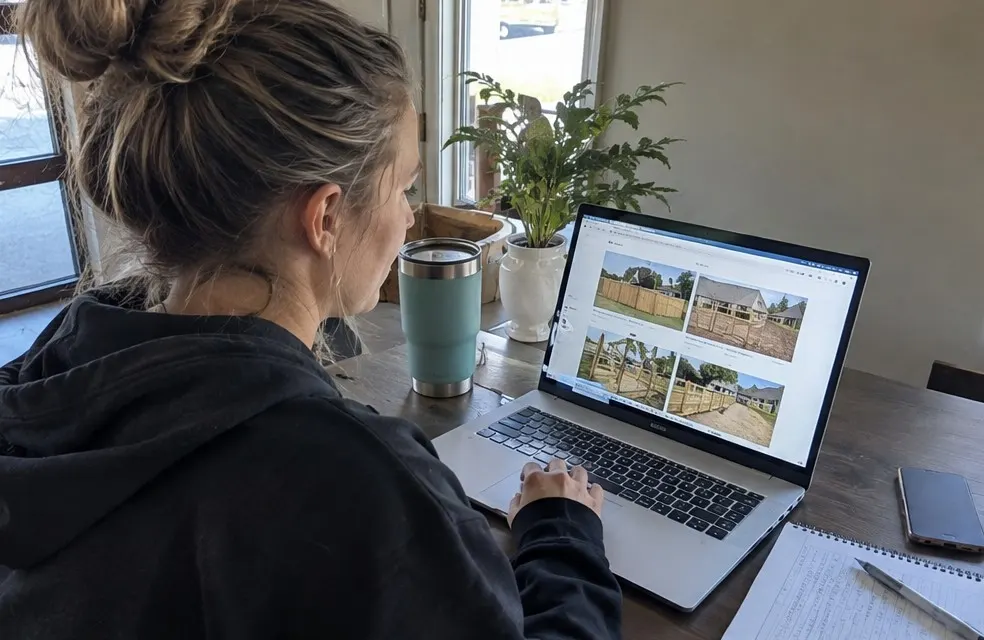
Real fences on real streets in your town. Before and after on replacements. Close-ups of gates and hardware. Stock photos look like every other site.
10. Reviews on the page
Show your Google rating and a few recent reviews near the calculator and the phone number. See how to get more Google reviews.
11. A short form and online booking
Name, phone, address, fence type and a time for the estimate. Every lead goes to your phone right away. Long forms with ten fields lose people.
12. A phone that gets answered
All of the above ends in a call. If you are on a job site and nobody answers, the website did its job and you still lost the fence. An answering service that quotes your prices closes the loop.
Bonus: speak your customers' language
In many markets, Spanish and Portuguese speaking homeowners are a big share of fence buyers. A site in English, Spanish and Portuguese reaches them before competitors do.
What to put on each fence type page
A good wood privacy page, for example, has a short description of the fence you build (height, post spacing, how deep the posts go, pine or cedar), photos of five or six of your own wood fences, the starting price and rate per foot, the add-ons (gates, tear-out, stain), how long an install takes, and three or four common questions. That is enough for Google to understand the page and for a homeowner to decide to call.
Common mistakes
- One page for everything. Google cannot match you to specific searches
- No prices anywhere. Visitors leave to find a site that gives them a number
- A Facebook page instead of a website. You do not control it, and it does not rank for "fence company in [town]"
- A site nobody updated since 2019. Old photos, an old phone number, a copyright year that tells visitors you might be closed
How long it takes
A good fence company website used to take weeks and thousands of dollars. FencePilot builds yours with your name, your prices and a page for every fence type and town, and texts you the link in a few minutes. You only pay if you keep it. See fence company website.
Frequently asked questions
What should a fence company website include?
A page for each fence type and each town, a calculator that shows a price range per foot, photos of your own fences, reviews, a tap-to-call phone number, a short form and online booking.
Should a fence company show prices on its website?
Yes, at least a range. Visitors who see a range and still call have accepted the number, so you drive to fewer estimates that go nowhere.